The 2026 Medicare Advantage (MA) and Part D (MA-PD) bid cycle led Medicare Advantage organizations (MAOs) to confront sustained margin compression and re-evaluate plan designs that had historically traded cost control for marketability—most notably preferred provider organizations (PPOs). Entering this cycle, MAOs faced elevated medical cost trends through 2024 that persisted through 2025, alongside both prescription drug utilization and cost volatility driven by the first year of the implementation of the Inflation Reduction Act (IRA) benefit redesign and uncertainty surrounding negotiated drug prices beginning in 2026. These pressures were compounded by MA rate updates that lagged underlying cost growth, contributing to deteriorating financial performance in 20241 and limiting room for error in 2026 bids. Against this backdrop, PPO plans, which are characterized by broader networks, out-of-network utilization, and more-limited utilization management, became increasingly misaligned with the financial realities MAOs continued to face. As a result, many organizations made deliberate shifts toward more-tightly managed plan designs, using reductions in PPO offerings as a primary lever to regain cost control, stabilize margins, and reduce exposure to utilization and pricing uncertainty.
On September 26, 2025, the Centers for Medicare and Medicaid Services (CMS) released the initial 2026 landscape file, providing the first view of plan sponsors’ 2026 plan design strategies. Further information on plan crosswalks and other cost sharing was released by CMS on November 5, 2025.
This paper highlights the key changes to plan offerings specific to the $0-premium PPO MA-PD general enrollment (non-special needs plans [non-SNPs]) market (excluding MA-only plans). We focus on these plans, referred to as $0 PPOs throughout this paper, because they combine the broad-network cost exposure of PPO designs with the tighter revenue constraints of a $0-premium product. As medical and drug costs accelerated and rate updates lagged trend, these plans left MAOs with limited ability to absorb higher utilization and claims volatility, making them a primary target for portfolio retrenchment in 2026. In addition, many carriers have removed broker commissions2,3 from these plans. These carriers, and others, have stated on earnings calls their intentions of closing these plans or reducing the plans’ service areas.4 This paper analyzes how carriers adjusted their $0 PPO offerings in response to these financial challenges and discusses considerations for the 2027 bid year.
Large number of 2026 $0 PPO plans account for a disproportionate share of 2026 plan exits
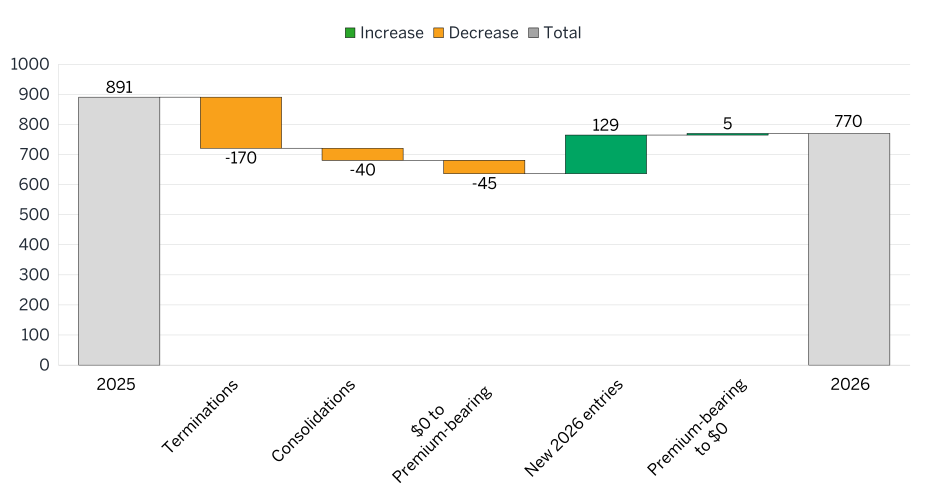
On a nationwide basis, the number of $0 PPO plans available to eligible members decreased significantly between 2024 and 2026, with most of the decrease occurring for the 2026 plan year. Figure 1 shows the net5 change in total plan count for $0 MA-PD PPOs between 2025 and 2026. The decrease in the number of $0 premium PPO plans has been more significant than the decrease in the number of premium-bearing plans. Between 2025 and 2026, $0 PPOs decreased more than 13% (891 to 770). While not displayed, premium-bearing MA-PD PPO plans have decreased a little over 9% (659 to 597). Out of the total net decrease of all non-SNP MA-PD plans from 2025 to 2026 (375), $0 PPOs accounted for a significant portion of this decrease (121 plans, or 32%).6
Figure 1: Change in number of $0 PPO plans, 2025 to 2026
The market experienced a sharp increase in the number of $0 PPO plans that either implemented service area reductions (SARs) or plan terminations since 2024
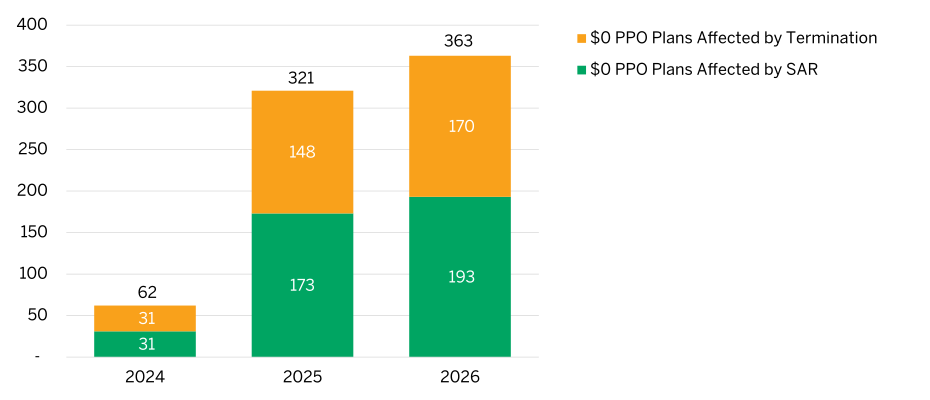
Figure 2 shows the number of $0 PPOs that implemented either SARs or terminated plans has increased by nearly five times (62 to 363) from 2024 to 2026. In each of the years, the proportion of plans with a SAR versus plan termination remained about the same (about 50% in each year). Additionally, while not displayed in Figure 2, the number of beneficiaries impacted by SARs or plan terminations from $0 PPOs has increased almost 30 times from 2024 to 2026 annual enrollment period (AEP) (based on membership in February as of the year prior to AEP), to nearly 1 million people.
Figure 2: Number of $0 PPO plans either SAR or termed, 2024 through 2026
$0 PPO plan terminations are widespread throughout the country
Figure 3a shows the map of net7 reduction of $0 PPO plans by county. There were pockets of net reductions of $0 PPOs throughout the country, with significant concentration in Minnesota, Illinois, and Pennsylvania, among other states.
Figure 3a: Change in number of $0 PPO plan offerings from 2025 to 2026 by county*
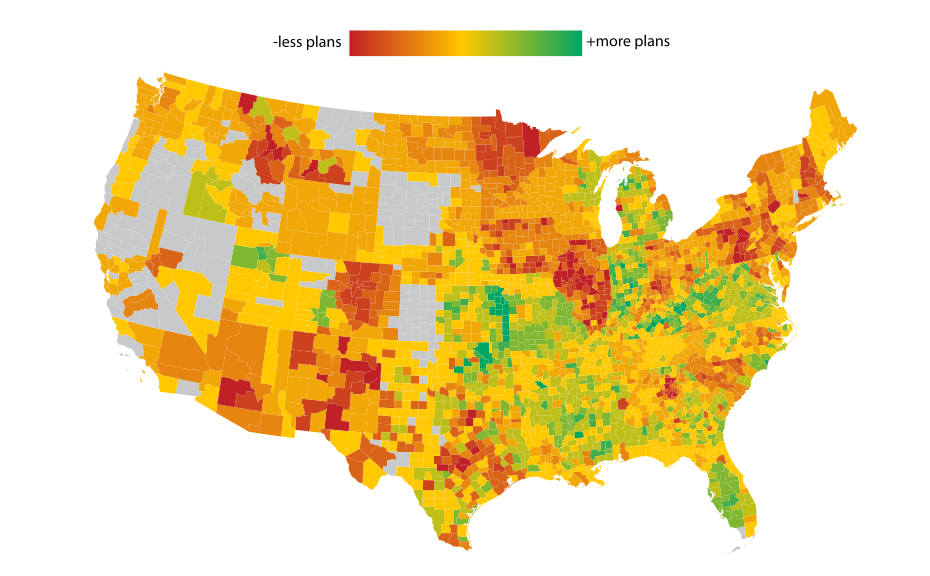
*Gray represents no $0 PPOs in both 2025 and 2026.
Figure 3b shows the number of $0 PPO plans offered in each county in 2026. There are very limited options for $0 PPOs in nearly all of the western United States, with many counties offering none of these plans at all. In reviewing both Figures 3a and 3b, the reader may note that there are certain areas, such as Pennsylvania, with a healthy contingent of $0 PPO offerings in 2026, though many also exited last year, alongside other states like eastern Minnesota/western Wisconsin and Vermont/New Hampshire, which now offer no $0 PPOs relative to prior years.
Figure 3b: Count of number of 2026 $0 PPOs, by county*
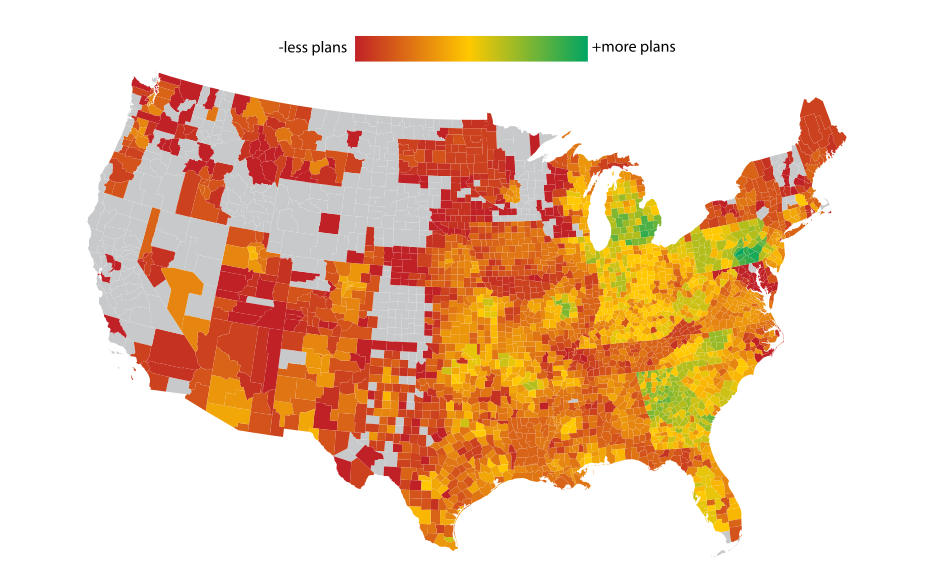
*Gray represents no $0 PPOs in both 2025 and 2026.
More $0 PPOs have changed to premium-bearing PPOs, with significant increases in the average premium
We analyzed the number of PPO plans that had a $0 member premium in the prior year and then added a premium the following year. Figure 4 displays these results.
The main takeaways from Figure 4 include:
- This dynamic has dramatically increased since 2024.
- The number of impacted plans has increased five times (eight to 45) since 2024, the impacted membership has increased almost 10 times, and the new average premium of these plans has increased 50%.
- The affected 308,000 members in 2026 represents about 5% of all non-SNP membership enrolled in $0 PPOs, while the 2024 affected membership represented about 0.6% of $0 PPO membership in that year.
Figure 4: $0 PPO plans changing to add a member premium the following year*
| AEP Year | # of Plans | Membership | Average Premium Per Member Per Month |
|---|---|---|---|
| 2024 | 8 | 33,000 | $23.00 |
| 2025 | 27 | 170,000 | $24.00 |
| 2026 | 45 | 308,000 | $34.50 |
*For each year displayed, the average premiums are member-weighted averages and are calculated prior to open enrollment. For example, the 2026 AEP year displays the membership as of September 2025, and the average premium is calculated based on this September 2025 membership. The 2025 AEP year uses membership as of September 2024, and the 2024 AEP year uses membership as of September 2023.
While local dynamics vary, Figure 4 highlights a pattern over the past three years that MAOs have been more willing to change $0 PPO to premium-bearing PPOs and to increase the premiums on those plans much more.
Cost-sharing changes are significant. However, the magnitude of changes in $0 PPOs aligns closely with premium-bearing PPOs.
MAOs adjusted some of the key in-network cost-sharing levers to improve financials, given the various headwinds they have faced. The results for two of these levers are displayed in Figure 5 (in-network medical maximum out of pocket [MOOP]) and Figure 6 (in-network specialist copay). The two figures show the member-weighted average cost-share amounts for the 2025 and 2026 plan designs, separately for $0 PPOs, premium-bearing PPOs, and health maintenance organizations (HMOs) (includes both $0 and premium-bearing plans).
The main takeaways from these graphics include:
- The average in-network MOOP and specialist copay for PPO products increased from 2025 to 2026, while these benefits remained essentially flat for HMOs (excluding point of service [POS] plans).
- The magnitude of cost-sharing increases for both $0 PPO and premium-bearing PPO plans were approximately the same, though the $0 PPO plans maintain the highest absolute cost sharing.
Figure 5: Average in-network medical MOOP for MA-PD non-SNPs, 2025 and 2026*
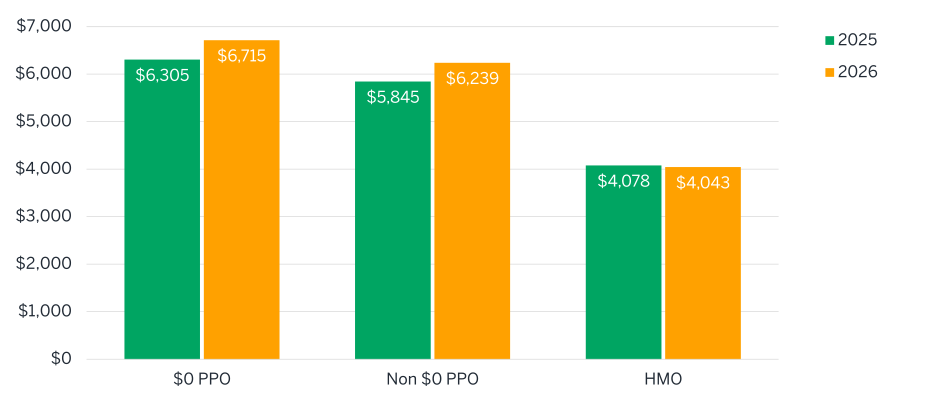
*The 2026 member-weighted averages are calculated prior to 2026 open enrollment, use September 2025 membership, and account for crosswalked plans. The 2025 member-weighted averages are calculated after 2025 open enrollment and use February 2025 membership.
Figure 6: Average in-network specialist copay for MA-PD non-SNPs, 2025 and 2026*
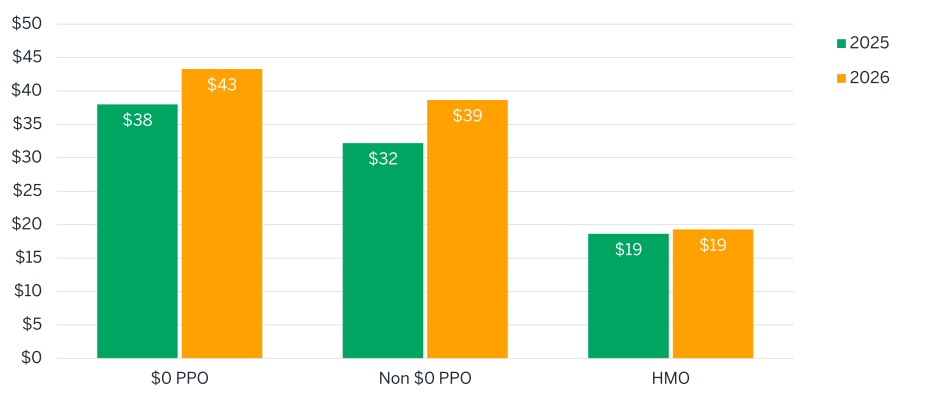
*The 2026 member-weighted averages are calculated prior to 2026 open enrollment, use September 2025 membership, and account for crosswalked plans. The 2025 member-weighted averages are calculated after 2025 open enrollment and use February 2025 membership.
Strategic considerations for MAOs entering the 2027 planning cycle
MAOs took a multifaceted approach with $0 PPO plans heading into 2026:
- A small number of $0 PPO plans added a premium heading into 2026, but this was a much greater proportion of all $0 PPOs than recent history. Medical cost sharing also continued to increase.
- Based on forced membership churn, the most significant levers MAOs used to address the financial pressures faced by $0 PPOs were to either terminate these plans or implement a SAR.
- Approximately 1 million members will be forced to choose a new plan due to either plan termination or SAR.
As MAOs look ahead to 2027 planning, the actions taken on $0 PPO plans for 2026 highlight both financial pressure and evolving member behavior that will shape future strategy.
- Portfolio rationalization versus member retention risk – The use of terminations and SARs emerged as the most impactful lever for managing the economics of $0 PPO plans, forcing approximately 1 million members to select a new plan. While this approach provides short-term financial relief, it may introduce material membership retention risk, particularly for members with strong preferences for the network flexibility of PPOs. MAOs should consider whether portfolio reductions (short of exiting a PPO contract entirely) will truly reduce PPO enrollment or simply shift members between plans.
- Will PPO enrollment actually decline? – Although plan terminations and added premiums may suppress some demand, sustained member preference for access and network breadth suggests that overall PPO enrollment may not materially decline in markets where PPO alternatives remain available. Instead, enrollment may re-sort toward fewer, more durable PPO offerings with higher cost sharing or modest premiums. The degree to which PPO enrollment shift will ultimately depend on county-level availability, competitive positioning, and the relative generosity of remaining PPO and HMO alternatives, making this a key area to monitor over the next several enrollment cycles.
- Pricing and benefit design tradeoffs – The addition of premiums and continued increases in medical cost sharing indicate that some MAOs are recalibrating the value proposition of $0 PPOs rather than fully exiting the PPO network product offering altogether. Strategically, plans must evaluate whether incremental premium and cost-sharing increases meaningfully improve margins without undermining competitiveness, particularly given that $0 PPOs already have the highest absolute cost-sharing levels on the key benefits we reviewed.
To better anticipate potential competitor actions, MAOs may want to consider proactive strategies to address the considerations outlined previously, alongside publicly available 2026 landscape information. Plans may also want to assess how member purchasing behavior and shopping preferences will evolve under these changing market dynamics. Early and sustained strategic planning throughout the 2027 bid development process will be critical to success in the MA market. The authors and Milliman consultants remain focused on these issues and are available to support further discussion and analysis as plans navigate these decisions.
Caveats, limitations, and qualifications
The information in this paper is intended to describe premium changes and trends in the MA market for $0 premium PPO plans. It may not be appropriate, and should not be used, for other purposes.
We relied on publicly available enrollment and premium data from CMS to support the data presented in this paper, as well as information from the 2024, 2025, and 2026 Milliman MACVAT®. We excluded Employer Group Waiver Plans (EGWPs), Prescription Drug Plans (PDPs), Medicare-Medicaid plans (MMPs), Medical Savings Account (MSA) plans, MA-only, SNPs and Cost plans. Plan counts are made at the contract-plan-segment level. If this information is incomplete or inaccurate, our observations and comments may not be appropriate. We reviewed the data for reasonability but did not audit the data.
The authors of this paper are members of the American Academy of Actuaries and meet the qualification standards of the American Academy of Actuaries to render the actuarial opinion contained herein.
1 Pierce, K., Feller, M., & Friedman, J. (May 12, 2025). Emerging Medicare Advantage and Part D trends from 2024 financial statements. Milliman. Retrieved February 10, 2026, from https://www.milliman.com/en/insight/emerging-medicare-advantage-part-d-2024-financial.
2 Tepper, N. (September 10, 2025). UnitedHealth, HCSC cut Medicare Advantage commissions. Modern Healthcare. Retrieved February 10, 2026, from https://www.modernhealthcare.com/insurance/mh-unitedhealth-hcsc-medicare-advantage-commissions/.
3 Tepper, N. (September 25, 2025). Humana ending commissions for some Medicare Advantage plans. Modern Healthcare. Retrieved February 10, 2026, from https://www.modernhealthcare.com/insurance/mh-humana-medicare-advantage-commissions-2026.
4 UnitedHealth Group. (July 29, 2025). Earnings conference call – second quarter 2025 remarks [Meeting transcript]. Retrieved February 10, 2026, from https://www.unitedhealthgroup.com/content/dam/UHG/PDF/investors/2025/UNH-Q2-2025-Remarks.pdf.
5 The total plan counts account for changes in both terminated plans and newly added plans.
6 Friedman, J. & Yen, I. (October 22, 2025). Navigating pressure in Medicare Advantage: How MA-PD plans are repositioning for 2026. Milliman. Retrieved February 10, 2026, from https://www.milliman.com/en/insight/navigating-pressure-ma-pd-plans-2026.
7 Net reduction accounts for both plan terminations and also new plans MAOs have added in those same counties.